


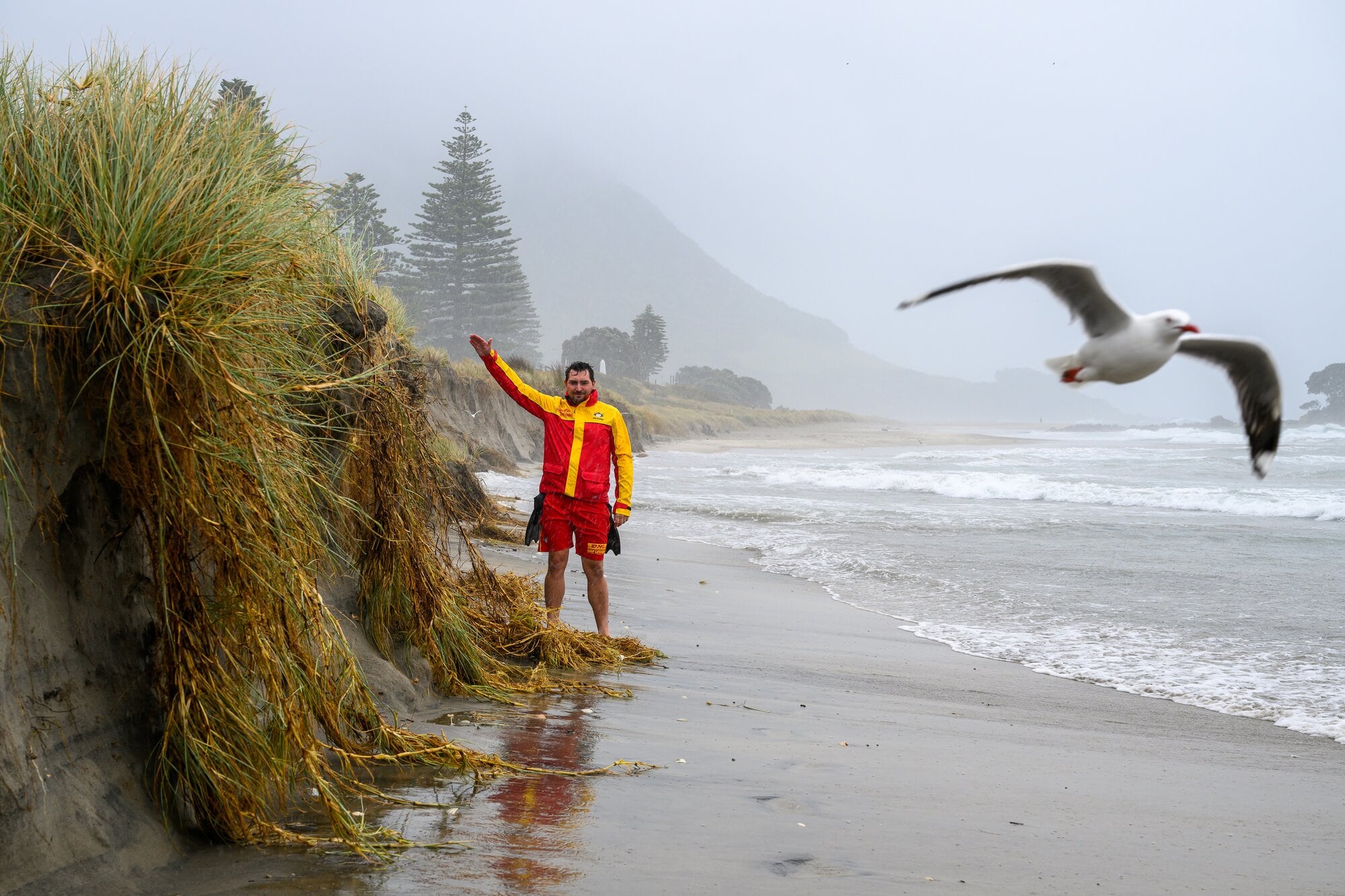
Surf Life Saving New Zealand is urging beachgoers to stay alert along the Mount Maunganui to Pāpāmoa coastline, where high sand dunes, eroded beach areas and strong rips are creating dangerous conditions ahead of a week of large swells.
Eastern region manager Chaz Gibbons-Campbell said recent inspections revealed “six-foot-high dunes and big drop-offs” in some areas, particularly near Banks Ave.
“We could hardly get through in the Can-Am buggy about an hour after high tide,” he said. “At Tay St, the water was up to the toe of the dunes, so it doesn’t leave much beach for sunbathing at high tide.”
He said people also need to be cautious when walking the beach at high tide.
“With the big swells coming, people could be walking along, and then big, surging waves could easily come and catch you off-guard and you’ve got nowhere to run, because it’s a big, high dune back there.”
He said he and life saving support officer David Cooper found the dunes near Banks Ave were unstable and crumbling while they were on-site.
“People need to be careful – don’t dig into or play around those dunes,” Gibbons-Campbell said. “Each high tide is eroding more sand away. We’ve seen how dangerous collapsing sandbanks can be.”
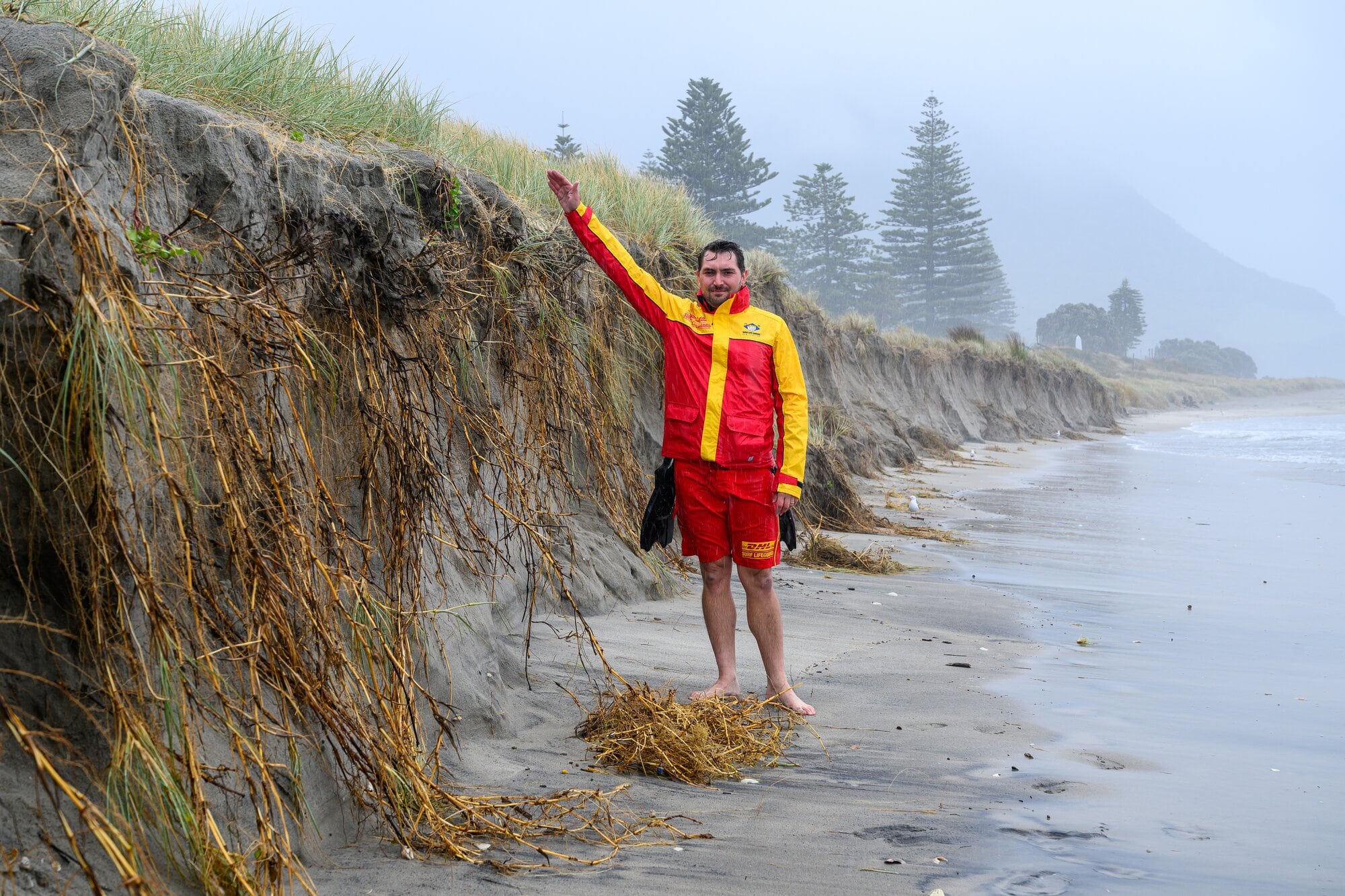
Surf Life Saving New Zealand Eastern Region manager Chaz Gibbons-Campbell demonstrating the height of the drop-off from the sand dune to the beach near Banks Ave, Mount Maunganui. Photo / David Hall
In August, father-of-four Kane Watson died in a sand dune collapse at Muriwai Beach, west of Auckland.
Erosion is not only threatening public safety – it also affects surf lifeguard operations, Gibbons-Campbell said.
“The high dunes and tides mean we can’t use ATVs along parts of the beach at high tide. We’ll need to rely more on jetskis and IRBs [inflatable rescue boats] out in the water to do preventative actions.”
Adding to the concern, a series of rescues last weekend highlighted how hazardous the surf had become. On November 8 an experienced swimmer was swept 400 metres offshore by a rip near Coast Boulevard, Pāpāmoa, before being rescued by a member of the public and lifeguards.
On November 9, a man and a child got caught in the same rip but were fortunately pulled to safety by beachgoers before emergency crews arrived.
“The banks along the coast are messy after winter – there are deep inshore holes and strong rips,” Gibbons-Campbell said.
“Heading into or coming out of low tide is when there’s a lot more water pulling, so you’ve just got to be more wary. You could be easily standing on a little sandbank and then step off and suddenly drop into a channel up to your neck.”

Surf Life Saving New Zealand Eastern Region manager Chaz Gibbons-Campbell next to the eroded sand dunes, showing the impact on the dune plant growth near Banks Ave, Mount Maunganui. Photo / David Hall
With swells and high tides forecast to increase next week, surf lifesavers urged swimmers to stick to patrolled areas.
“Swim between the red and yellow flags, avoid walking close to the dunes at high tide, and stay alert,” Gibbons-Campbell said. “Lifeguards can’t be everywhere, so people need to know how to keep themselves and their families safe.”
Volunteer lifeguards are on duty on weekends from 11am-4pm throughout November.

3 comments
Natures cycle
Posted on 14-11-2025 08:49 | By Fred Bear
The pictured erosion scene, minus our human, has occurred hundreds of thousands of times - a cycle that includes ice age events that took the Mount surf beach miles out to sea for long periods, leaving forests to populate Tauranga estuaries and the long coastline. The hero plant for our sand stability is the humble spinifex and its tumbleweed seed heads, an indigenous plant that coast carers worldwide wish they had. Our dune 'weed' grows aggressively with rope-like tendrils, which, if left alone accelerates the dune recovery by capturing wind-bourne sand particles by their sheltering effect, whereby the surface wind-speed is lowered by their leaves - causing blown sand particles to fall down. So people, please keep away from eroded areas and let the plants bring our beach back - it just takes time and applied human patience.
I couldn’t agree….
Posted on 14-11-2025 11:56 | By Shadow1
…more Fred. If you walk any beach regularly, you’ll see that the side currents don’t take the sand away, they just drop it further along the beach. Then the wind blows it back to the dunes.
There are ways to trap the sand in place by using stone groins or as a last resort bring in the bulldozers. A D8 or D9 can move an incredible amount of sand in a day. No one could complain about that as you would be putting the sand back where it came from.
Shadow1.
Don't play with sand
Posted on 15-11-2025 07:17 | By Fred Bear
Addressing Shadow1, I have a very long association with coastal erosion and have kept a photographic record. 'Soft' methods to assist plants to trap sand do work whereas brutal interference is a deep money pit with a total failure risk as is readily seen around the world. Reinstating 'lost-sand' beaches is an ongoing cost in places where it 'works', such as at Pilot Bay, or Oriental Bay (Wellington) - being sheltered locations, however fiddling with an ocean beach is fraught with risk and ultimate failure as the enormous power of storm surges powering over hidden and ever moving near-shore sandbars can at times focus on random parts of the BoP, moving a million tonnes of sand around in no time. The BoP has a relatively special existence, for example the rapid accumulation of sand at Waiotahi, and 'damaged' beaches westward that appear to have 50 to 100 year cycles.
Leave a Comment
You must be logged in to make a comment.