


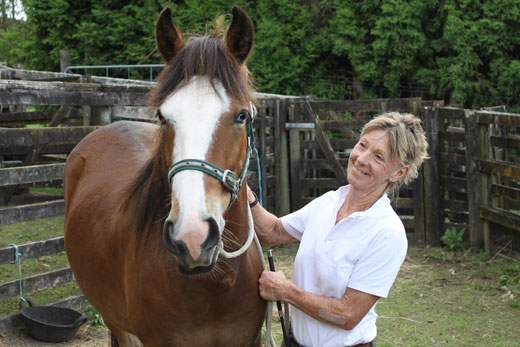
Although he was born into a freely roaming Kaimanawa herd, Kai no longer shows signs of his wild beginnings, apart from the distinctive genetic traits which make his kind so special.
Kai has blossomed from a shaky, nervous foal to a confident young horse thanks to the care and attention of owner Ruth Woodward and her mentor Gill Page.
These he displays through his compact, muscular physique and gentle, intelligent, inquisitive nature.
Less than two years after his capture, during the 2012 Kaimanawa Horse Muster, Kai is as yet unbroken for riding but happily allows his owner Ruth Woodward to halter, pet and groom him and sit on his back.
'He has such a sweet nature and I know he will be a fabulous friend for a child,” says Ruth, who had no intentions of owning a Kaimanawa horse until she was persuaded by friend Gill Page.
Gill, who lives on a lifestyle block near Whakamarama with her husband Graham, owned two Kaimanawa horses. They were ‘adopted' after the muster in 2011 and Gill was determined to take two more and help find homes for those rounded up in 2012.
'There were just two days until the adoption offers closed and there were still many horses left, which would end up at the slaughter house unless homes were found,” says Ruth, who is a near neighbour to Gill.
Life saved
Ruth already had two horses on her four hectare block but knew her decision to ‘adopt' another would mean life, not death, for a little Kaimanawa colt, so she filled in the forms.
Following the muster in May 2012, Kai and two other colts adopted by Gill arrived at the Page farm. 'They were frightened, pot-bellied, woolly, dishevelled and gorgeous. The woolly bay with the wild mane, full face blaze and two blue eyes – what a little cracker – we decided he was for me,” says Ruth, who has never regretted her decision to take the colt.
Kai stayed at Gill's property with her two colts, Munchkin and Jiminy, for eight weeks until he was completely happy around humans, including of course Ruth, who visited daily, initially sitting in the paddock with the colts until their natural curiosity prompted them to come close enough to sniff her and finally allow her to touch them.
'By then he was comfortable enough with Ruth – and to be led – to be loaded into a float,” says Gill.
Gill, who is a professional groom, a qualified riding instructor and has bred horses in the UK, did the same with Munchkin and Jiminy, based on her extensive experience of breaking in horses; and from what she had learned from her first two Kaimanawa horses, Mocha and Ginge.
Initially, she had real concerns for Munchkin. 'He was tiny and looked malnourished. I think he must have been still feeding from his mother but they got separated in the muster.” Usually, mares with foals at foot are kept together and go to the same home.
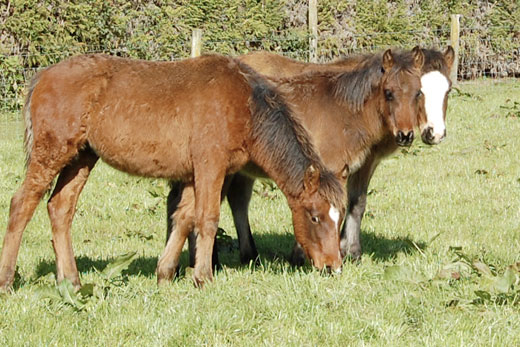
Kaimanawa foals Jiminy Munchkin and Kai (far right), shortly after they arrived at Gill and Graham Page's Whakamarama property. Photo by Ruth Woodward.
Eighteen months on, the confident, handsome horse which trots up the paddock for a pat and scratch from Gill bears little resemblance to the scrawny baby of May 2012 – and even Gill is impressed at his transformation. 'His is a real ugly-duckling-to-handsome-prince kind of story,” she says. However, from their first day on her farm, the three have been taking lessons in ‘horse etiquette', much of it from 21-year-old retired race horse Aunty Chime Dorjee. Gill adopted the mare who had been rescued by the SPCA and says she helps settle the young Kaimanawa horses and teaches them how to behave.
Both Gill and Ruth are Kaimanawa fans and want to encourage others to ‘adopt' horses at this year's muster.
'The very old, sick or injured horses and any for which homes can't be found are culled; and often there are some lovely horses among those which are slaughtered,” says Gill.
This is why she and Ruth are encouraging anyone who loves horses and who has the time and skills to train them, to consider adopting a Kaimanawa horse this year. The horses cost about $275 plus transport, with the money going to Kaimanawa Heritage Horses, the organisation which is a non-profit charitable trust dedicated to the welfare of Kaimanawa horses in both the wild and domestic environments.
'It takes a special kind of person to adopt a Kaimanawa because they need time and attention to make the adaption from their life in the wild. They can be spirited and like any horse, will defend themselves if ill-treated or threatened but there is nothing wild or malicious in their natures.
'Handled with care and gentleness, they reward you in so many ways and make fantastic ponies for young people,” says Gill.

0 comments
Leave a Comment
You must be logged in to make a comment.